
The Origins of the Method
Joseph Pilates & the Classical Method
Every session at Pilates Connection traces back to one man’s fifty-year pursuit of a stronger, better-controlled body — and the exact system of apparatus and exercises he left behind.
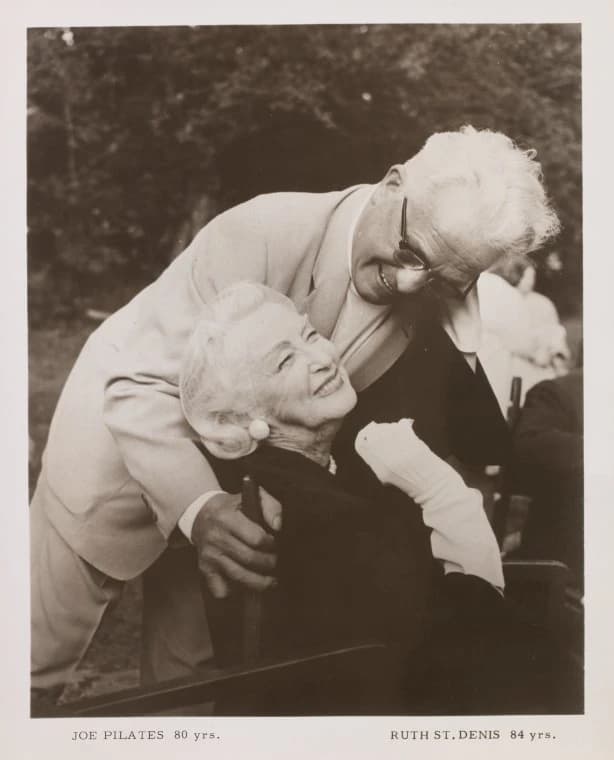
Joseph Pilates with his client Ruth St. Denis, c. 1954–1960. Image: New York Public Library, Jerome Robbins Dance Division (no known copyright restrictions).
Early Life
A sickly child who rebuilt himself
Joseph Hubertus Pilates was born on December 9, 1883, in Mönchengladbach, Germany. As a boy he suffered from asthma, rickets, and rheumatic fever — a childhood frail enough that he devoted the rest of his life to reversing it.
He studied anatomy obsessively and trained across an unusual range of disciplines — gymnastics, boxing, wrestling, diving, and skiing — building a body of knowledge that drew equally from Eastern and Western movement traditions. By his twenties, the sickly child had become a self-taught expert in physical conditioning.
Wartime Innovation
Contrology, behind the wire
Pilates was living in England when the First World War broke out, and as a German national he was interned — first at Lancaster Castle, where he taught wrestling and self-defense to fellow internees, then at the Knockaloe camp on the Isle of Man.
It was there that he began developing the integrated system of exercise he called “Contrology.” To keep bedridden internees moving, he rigged springs from hospital bed frames, giving patients resistance to push and pull against from a supine position — the direct ancestor of the spring-loaded apparatus still built today.
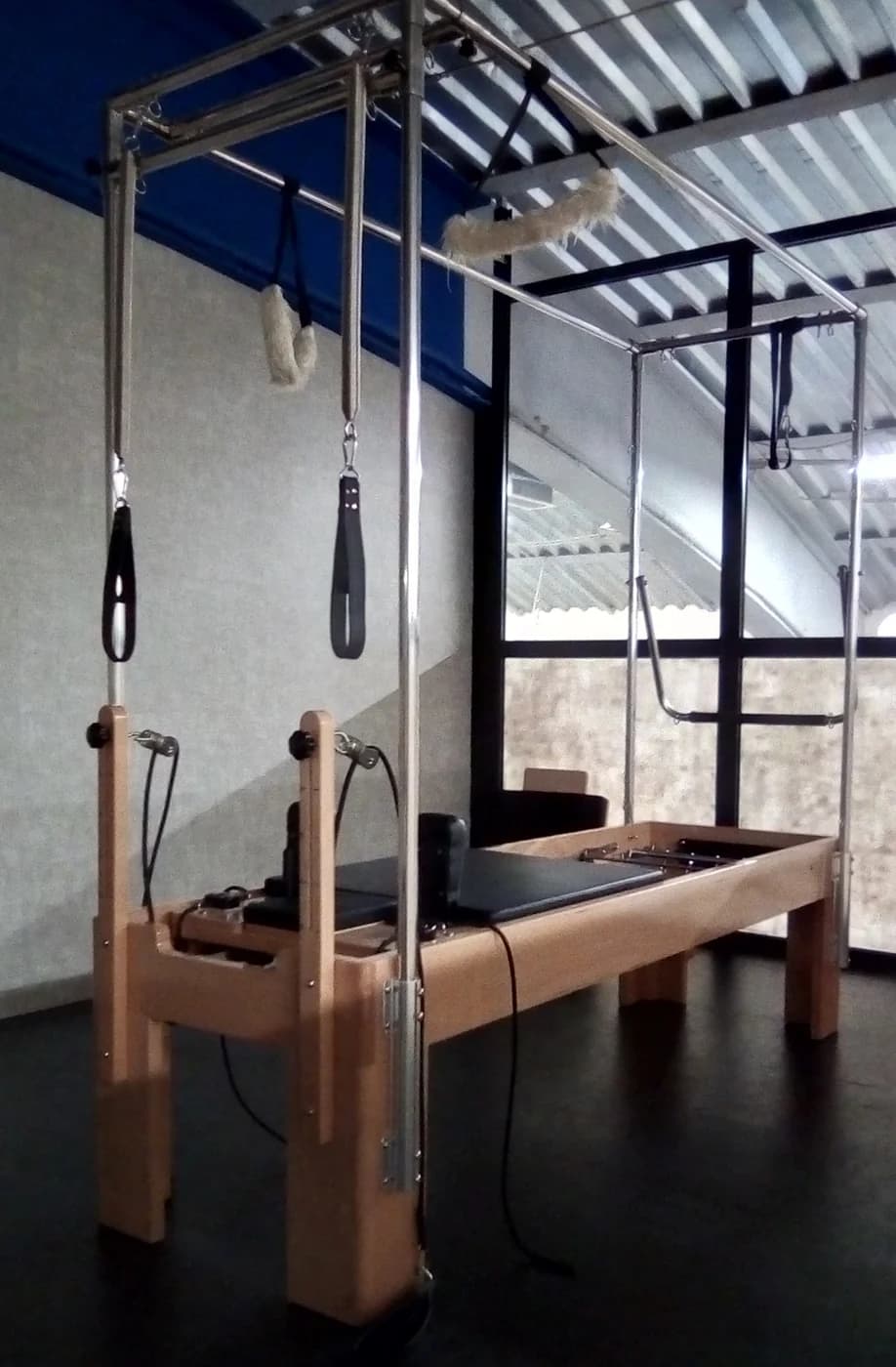
Apparatus photo: Grumbler eburg, CC BY-SA 4.0, via Wikimedia Commons.
“Contrology develops the body uniformly, corrects wrong postures, restores physical vitality, invigorates the mind, and elevates the spirit.”
Joseph Pilates, Return to Life Through Contrology, 1945
The New York Studio & Legacy
Eighth Avenue, and everything after
Pilates emigrated to New York in 1926 and, with his wife and collaborator Clara, opened a studio on Eighth Avenue in Manhattan — in the same building as several dance studios. Dancers including George Balanchine and Martha Graham sent students to Joseph and Clara for conditioning and injury rehabilitation, and modern-dance pioneer Ruth St. Denis became a lifelong client and friend. The method spread through the concert dance world long before it reached the general public.
Pilates continued teaching and refining his apparatus — the Universal Reformer, the Cadillac, the Wunda Chair — until his death in New York in 1967. His students, later known as the “Pilates Elders,” carried his exact order of exercises and equipment design forward, forming the classical lineage that traces in an unbroken line back to that studio on Eighth Avenue.
At Pilates Connection
The classical method, taught as it was designed
Our staff trains and certifies through Peak Pilates, one of the organizations dedicated to preserving Joseph Pilates’ original apparatus, sequencing, and intent. When you take a session here, you’re not doing a modern reinterpretation — you’re doing Contrology, on equipment built to the classical spec, in the order Joseph Pilates designed it.